Your Insurance Company Flagged Your Electrical Panel. Now What?
If you just opened a letter telling you your home’s electrical panel needs to be replaced before your insurance policy renews, you’re probably somewhere between confused and panicked. That letter might be the first time you’ve heard the words “Federal Pacific” or “Zinsco,” and now you’re being told you have 30 to 90 days to fix a problem you didn’t know existed. Our team handles panel replacements and upgrades regularly in the Columbia and Lexington area, so let me walk you through what’s going on, why it matters, and what it takes to fix it.
Why These Panels Are a Problem
(and Not Just an Old-House Quirk)
Federal Pacific Electric, usually called FPE, was one of the most popular panel manufacturers in the country from the 1950s through the 1980s. Millions of homes were built with their Stab-Lok breakers. The problem isn’t that these panels are old. The problem is that the breakers inside them don’t do their job.
A circuit breaker has one purpose: when a wire carries more current than it can handle, the breaker trips and cuts power before the wire overheats. Independent testing, most notably by a New Jersey engineer named Jesse Aronstein and later supported by the Consumer Product Safety Commission’s own findings, showed that FPE Stab-Lok breakers fail to trip roughly 25 to 30 percent of the time. Some double-pole breakers failed at rates as high as 60 percent. When a breaker doesn’t trip, the wire keeps heating. That’s how electrical fires start.
The natural follow-up question is: if they’re that dangerous, why weren’t they recalled? The CPSC investigated FPE in the 1980s and found that the company had fraudulently obtained its UL safety listings, meaning many of these breakers were never properly tested to the standards they claimed to meet. But by the time the investigation wrapped up, FPE had gone out of business. The CPSC chose not to pursue a mandatory recall on a defunct company’s product. So the answer to “why no recall” is bureaucratic, not safety-based. The breakers are just as dangerous whether or not a government agency followed through on paperwork.
Zinsco panels, which also appear under the names Sylvania, GTE Sylvania, and Magnetrip, have a different but equally serious set of problems. Manufactured from the 1960s through the 1980s, Zinsco panels use aluminum bus bars that corrode and degrade over time. The breakers can physically fuse to the bus bar, making them impossible to trip even by hand. Worse, a Zinsco breaker can appear to be in the “off” position while still conducting electricity because it has melted into the bus bar. That’s not a minor defect. That’s a panel where what you see and what’s happening electrically are two different things.
How to Tell What’s in Your Panel
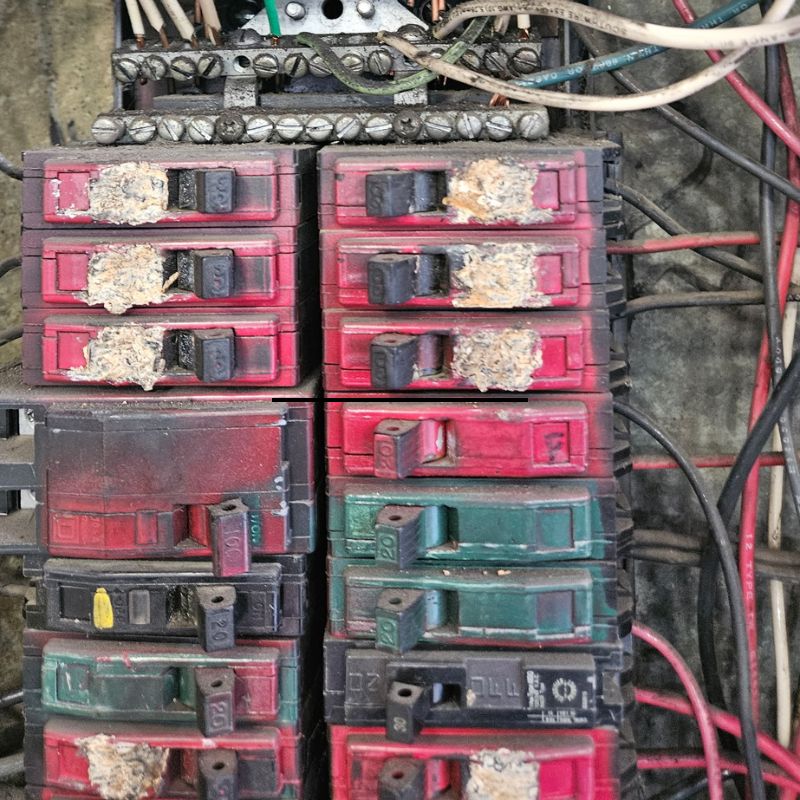
If you’re not sure what brand of panel you have, start with the label on the panel door, usually found on the inside. FPE panels will say “Federal Pacific Electric” or “FPE,” and the breakers inside will have a distinctive red stripe on the toggle. Zinsco panels will say “Zinsco,” “Sylvania,” or “GTE Sylvania,” and the breaker handles are often colorful (blue, red, green, or tan) rather than the standard black you see on modern breakers.
If you’re in the Columbia area, the odds aren’t small. About 32 percent of homes here were built between the 1940s and 1960s, and many still have their original electrical panels. Neighborhoods like Shandon, Rosewood, Forest Acres, Cottontown, Elmwood Park, Eau Claire, parts of West Columbia, and older sections of Lexington and Irmo are where we see these panels most often.

What Happens When Your Insurer Sends That Letter
A growing number of insurance companies are refusing to write new policies or renew existing policies on homes with FPE or Zinsco panels. From the insurer’s perspective, the math is simple. Electrical failures cause roughly 13 percent of home structure fires according to NFPA data, and FPE and Zinsco panels have documented failure rates that are far higher than modern equipment. That’s a liability they’re choosing not to carry.
Several things can trigger an insurance panel review. A policy renewal on an older home, a new policy application (common when you’re buying a house), a claim filed on the property, or your home crossing an age threshold, typically 30 to 40 years. Once flagged, you’ll usually get a notice with a compliance window of 30 to 90 days to have the panel replaced. Some insurers give shorter windows. Some won’t write the policy at all until the work is done.
If you’re buying a home and your insurer flags the panel during the application process, that’s a negotiation point with the seller worth understanding. In a market where the median home price in Columbia sits around $271,000 and has climbed 4.3 percent year over year, panel issues come up in transactions regularly. Neither buyers nor sellers should be blindsided by this.

It’s Not Just FPE and Zinsco
Two other panel types sometimes show up on insurance flagging lists. Challenger panels, made in the 1980s and 1990s by Challenger Electrical Equipment Corp (later acquired by Eaton), had breaker connection issues in some models. They’re not universally blacklisted the way FPE and Zinsco are, but some carriers flag them.
Pushmatic panels, made by Bulldog Electric and later ITE/Siemens, use a push-button design instead of toggle switches. They’re not inherently defective like FPE panels, but they’re old, replacement parts are scarce, and some insurers flag them based on age alone.
It’s also worth mentioning aluminum wiring, which isn’t a panel brand but often gets flagged alongside panel issues. Columbia-area homes built in the late 1960s through the mid-1970s may have aluminum branch circuit wiring, which has its own set of risks at connection points. If your panel gets flagged and your home is from that era, the wiring may come up too.
What Ignoring the Notice Gets You
If you let the compliance deadline pass without acting, your insurer will drop your coverage. That doesn’t mean you go without insurance. You’ll likely end up in the surplus or excess lines market, which is a secondary insurance market for properties that standard carriers won’t touch. The coverage is the same on paper, but the cost is not. Expect to pay two to three times what you’re paying now. On a home in the Columbia market, that could mean an extra $1,500 to $3,000 a year in premiums, every year, for as long as you own the home with that panel.
Compared to the one-time cost of a panel replacement, the math tips toward replacing it quickly.
What the Replacement Looks Like (Cost, Timeline, and Permits)
A standard panel replacement, swapping your FPE or Zinsco panel for a modern panel at the same amperage, typically takes one electrician 6 to 10 hours. In the Columbia market, that runs between $1,800 and $3,500, depending on the panel brand, size, and the condition of the existing wiring.
If the service also needs an upgrade, which is common in older homes here, the scope grows. Many of these homes are still running 100-amp service, which was standard when they were built but falls short of what a modern household draws. Upgrading to 200-amp service means the meter base may need replacement, the service entrance cable may need upgrading, and Dominion Energy needs to schedule a disconnect and reconnect. That extends the job to one to two days and puts the cost in the $2,500 to $6,500 range, sometimes higher depending on the specifics.
South Carolina requires a permit for panel replacements. In Richland and Lexington Counties, the electrician pulls the permit (homeowners can’t pull electrical permits for work over $250 in SC). After the work is done, a county inspection is required before the job is considered complete. If the meter needs to be pulled, Dominion Energy has to schedule that separately, which can add one to three business days depending on their queue. When you’re working against an insurance compliance deadline, that scheduling piece matters. Build it into your timeline.
One more thing worth knowing about our area: South Carolina’s humidity and frequent thunderstorms accelerate corrosion inside panels. A panel that might limp along in a dry climate degrades faster here. That’s not a scare tactic. It’s a climate reality that compounds the existing problems with FPE and Zinsco equipment.
Where This Leaves You
If you’ve gotten a letter, you’re not in a unique situation. This is happening across Columbia and Lexington to homeowners who had no idea their panel was a known problem. The good news is that a panel replacement is a straightforward job for a licensed electrician. It’s not a renovation. It’s not a week-long project. It’s a defined scope of work with a clear outcome: a modern panel that does what it’s supposed to do, and an insurance company that has no reason to drop your policy.
If you’re not sure what panel you have, open the door and look at the label. If it says Federal Pacific, Zinsco, Sylvania, or GTE Sylvania, you now know what you’re dealing with. And if you’ve already gotten the letter, start the process sooner rather than later. Between permit timelines, Dominion Energy scheduling, and your compliance window, the calendar matters more than you’d think.
-Steven Scheeler, Rytec Electric
