
5 Warning Signs Your Home Has an Electrical Problem
Every year, electrical failures and malfunctions cause nearly 47,000 home fires across the United States, killing roughly 390 people and injuring over 1,300 more. Here in South Carolina, the numbers hit closer to home. Electrical problems are the single leading identified cause of fatal house fires statewide, and our residential fire death rate runs about 72% higher than the national average.
May is National Electrical Safety Month, and it’s a good time to walk through the signs that something in your home’s wiring may not be right. Most electrical problems don’t announce themselves with sparks and smoke. They build quietly inside walls, behind outlets, and in your panel, sometimes for months or years before something goes wrong. The good news is that they usually give you warnings first, if you know what to look for.
That’s what this post is about. We’re going to walk through five warning signs that tell you it’s time to call an electrician for an electrical safety inspection. Some of these are obvious once you know them. Others might surprise you.
1. Circuit Breakers That Keep Tripping
A breaker tripping once in a while isn’t unusual. You plug in the space heater while the microwave is running, the breaker does its job, you reset it, and move on. That’s normal.
What’s not normal is a breaker that trips repeatedly, especially on the same circuit, or when you can’t point to an obvious reason.
When a breaker trips, it’s telling you the circuit is drawing more current than it can safely handle. The breaker is your safety net. It cuts the power before the wires overheat. Most people don’t think about what happens when you just keep flipping it back on without figuring out why it tripped. You’re asking that breaker to catch the same problem over and over again. And eventually, breakers wear out. A breaker that stops tripping isn’t one that fixed itself. It’s one that’s no longer protecting you.
The cause could be straightforward, like too many devices on one circuit that needs to be load-balanced or split. But it can also point to something more serious: frayed wiring, a loose connection, or deteriorating insulation inside the wall. These create short circuits and ground faults that trip breakers for a very good reason.
If you’ve got a breaker that trips more than once or twice a month, or one that trips for no apparent reason, that circuit needs to be evaluated by a licensed electrician. The fix might be as simple as redistributing your loads or adding a dedicated circuit. Or it might mean your panel needs an upgrade. That’s common in older homes built with 100-amp service and are now trying to run modern appliances, HVAC systems, and electronics that didn’t exist when the house was wired.

2. Flickering or Dimming Lights
We’re not talking about a single bulb that needs to be screwed in tighter. We’re talking about lights that flicker or dim across multiple fixtures, or your whole house dimming briefly when the AC kicks on, or someone turns on the hair dryer.
That usually means there’s a loose or deteriorating connection somewhere in your electrical system. It could be at an outlet, a switch, a junction box, or in the panel itself. Loose connections lead to something called arcing, which is when electricity jumps across a gap instead of flowing through a solid connection the way it’s supposed to.
That’s a big deal. According to the NFPA, arcing is the heat source behind nearly three out of every four home fires involving wiring and electrical equipment. Arc temperatures can exceed 10,000°F, which is more than enough to ignite wood framing, insulation, and anything else nearby. It often happens inside walls where you can’t see it.
The Consumer Product Safety Commission estimates that nearly half of all home electrical fires could be prevented with arc-fault circuit interrupter (AFCI) protection. These are devices specifically designed to detect dangerous arcing and shut the circuit down before it becomes a fire. If your home was built before 1999, it’s almost certain you don’t have them.
If your lights flicker or dim regularly, don’t write it off. Have an electrician trace the issue. It may be a loose connection that takes 20 minutes to fix, or it may be something that’s been building inside your walls for a while.
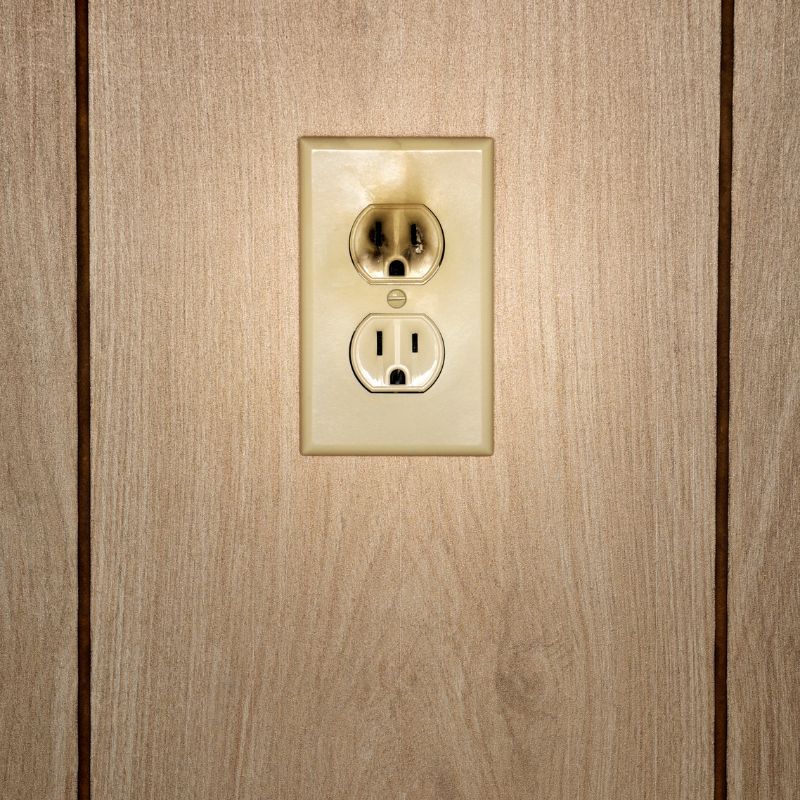
3. Warm, Discolored, or Scorched Outlets
This one seems more obvious, but only if you’re paying attention. Most of us plug something into an outlet and don’t think about that outlet again for years. So next time you’re near one, put your hand on the cover plate. Is it warm? Look at it. Is there any yellowing, browning, or dark marks around the outlet? Does the plug feel loose when it’s inserted?
If the answer to any of those is yes, something is wrong at that outlet. It could be a loose connection generating heat, worn contacts that no longer grip the plug properly, or a circuit carrying more load than it was designed for. In any of those cases, the outlet is producing heat, and that heat has to go somewhere. Often, it goes into the wall behind it.
The CPSC identifies warm or hot outlet covers as a sign of an unsafe wiring condition that needs immediate attention. They’re not being dramatic. Electrical receptacles are involved in roughly 5,300 home fires a year. If you find a warm or discolored outlet, stop using it. If you can, cut power to that circuit at the panel, then call an electrician. The problem is already happening. You’re not trying to prevent something down the road. You’re catching something in progress.
This goes double if your home was built between 1965 and 1973, when aluminum branch-circuit wiring was common. According to the NFPA, aluminum connections are prone to a type of deterioration that increases resistance and produces heat over time. The CPSC recommends that homes with aluminum wiring have it evaluated and repaired by a qualified electrician.
4. A Burning Smell You Can’t Find
You walk into a room and catch a whiff of something: burning plastic, hot metal, something electrical. You look around and can’t find the source. Maybe it fades after a minute. Maybe it comes and goes.
This is the one on this list that should get you on the phone the fastest.
What you’re likely smelling is wire insulation overheating or melting inside a wall cavity. It could be arcing at a hidden connection, sustained overcurrent degrading the wiring, or brittle cloth or rubber insulation in older homes that’s broken down to the point where conductors are making contact.
The reason this one is so urgent is that electrical fires can burn inside wall cavities for a long time before you ever see flames or smoke. According to the NFPA, fires that ignite between midnight and 8 a.m. account for just 22% of electrical fires, but over half of all deaths. Those overnight fires often start in concealed wiring while everyone is asleep.
The smell isn’t always what people expect, either. Overheating electrical components can produce a distinct fishy or chemical odor that most homeowners don’t associate with wiring at all. We actually wrote a whole post about that: why your home might smell fishy and what it means.
If you notice a burning or unusual chemical smell near an outlet, switch, or your panel, even if it’s faint or comes and goes, don’t wait on it. Call an electrician that day. Getting it checked and finding nothing wrong is a better outcome than waiting and finding out the hard way.
5. Two-Prong Outlets or No GFCI in Wet Areas
This last one isn’t about a sudden symptom. It’s about something your house has been telling you the whole time.
If you’ve got outlets with only two slots and no third ground hole, your home’s wiring is ungrounded. That means there’s no safe path for fault current if something goes wrong with an appliance or a wire. Instead of flowing safely to ground, that current can flow through you.
Two-prong outlets were standard in homes built before the mid-1960s, but the National Electrical Code started requiring grounded receptacles in 1962. If your home still has them, it’s been out of code for over 60 years.
Similarly, if you don’t see “TEST” and “RESET” buttons on outlets in your bathrooms, kitchen, garage, or outdoor areas, you probably don’t have GFCI protection. GFCI outlets detect dangerous ground faults, the kind that cause electrocution, and shut the circuit off in about 1/40th of a second. A standard breaker doesn’t react to those low-level faults at all. The CPSC estimates that GFCIs could prevent a significant share of the roughly 300 electrocutions that occur in and around the home each year.
GFCI requirements have been phased into the electrical code over the decades. Bathrooms were added in 1975, garages in 1978, and kitchen countertops and outdoor areas came in later code cycles. If your home was built before those dates, it may have none.
The fix depends on your situation. GFCI outlets can be installed in wet areas even on ungrounded wiring. They won’t provide a ground path, but they will provide the shock protection. Full grounding means running a ground wire to each outlet, which is a bigger project. An electrician can look at your specific setup and walk you through the options.

A Quick Note About Columbia and Midlands Homes
If you live in the Columbia metro, whether that’s Lexington, Irmo, West Columbia, Forest Acres, or the surrounding areas, your home’s age matters here. The median year a home was built in the Columbia area is 1978, which puts a lot of local housing stock right in the window where these issues are most common: ungrounded wiring, no GFCI, no AFCI, aluminum branch circuits, undersized panels, and aging insulation.
Neighborhoods like Shandon, Elmwood Park, and Heathwood were largely built in the 1920s through the 1950s. Forest Acres and Kilbourne Park are mostly from the 1940s through the 1960s. Even the Lexington and Irmo homes built in the 1970s through 1990s may have panels and wiring that are showing their age after 30 to 50 years of service.
This isn’t a reason to panic. It’s a reason to pay attention to what your house is telling you, and to have it checked if something doesn’t seem right. One more thing worth knowing: when electrical work is permitted in South Carolina, the area being worked on has to meet current code. That means if you’re doing a renovation or addition, it’s a good opportunity to bring the electrical system in that part of your home up to modern safety standards while the walls are already open.
What to Do Next
If anything in this post sounded familiar, whether it’s a breaker that won’t stay on, lights that flicker when the AC runs, an outlet that’s warm to the touch, or a smell you can’t quite place, it’s worth having a professional take a look.
An electrical safety inspection goes through your panel, wiring, outlets, and connections to identify problems before they become emergencies. It gives you a clear picture of where your home stands and what, if anything, needs attention.
At Rytec Electric, we work with homeowners across the Lexington, Columbia, and Midlands area every day on exactly these kinds of issues, from panel upgrades and circuit repairs to full rewiring in older homes. If you’d like to schedule an electrical safety inspection, give us a call or book online. We’ll walk through your home’s electrical system with you and make sure everything is where it should be.
