
A Brief History of Home Electrification
Electricity is something we all take for granted. Whether we’re charging our phones in our cars, running a load of laundry, or enjoying the cool breeze of our AC on a hot summer day, electricity has forever changed how we live. But it was just over a century ago when you were just as likely to find gas lights and candles as light bulbs, and outside of big cities, you were unlikely to find any electricity at all!
Today we’re going to quickly cover the early history of electricity in the United States, focusing on the developments that lead to its modern ubiquity.
And Edison said, “Let there be light”
Thomas Edison is perhaps the best known American inventor, and while it is easy to see where his reputation came from, it is perhaps overstated.
In 1880 Edison received a patent for an “electric lamp,” or what today we more commonly refer to as a light bulb. This was not the first patent for an electric lamp – but did include several key improvements which made the product more viable for mass market consumption.
Even though Edison’s name is on the patent – the invention was actually a product of his New Jersey-based laboratory, which was well funded and included a dedicated team of researchers, each of whom was an expert in their respective fields.
However, the invention of a reliable and safe light bulb didn’t initially make much of a difference in the average American household. The reason for this was simple: in 1880 there were zero homes which were wired for electricity. The first home wouldn’t receive electricity until 2 years later when J. P. Morgan (of banking fame) had Edison’s company wire his New York residence.
This first attempt at home electrification was plagued by mechanical problems and the Morgan family had Edison’s primitive electrical system replaced by the end of 1883. Despite this rocky start, the electrification of American homes had truly begun.
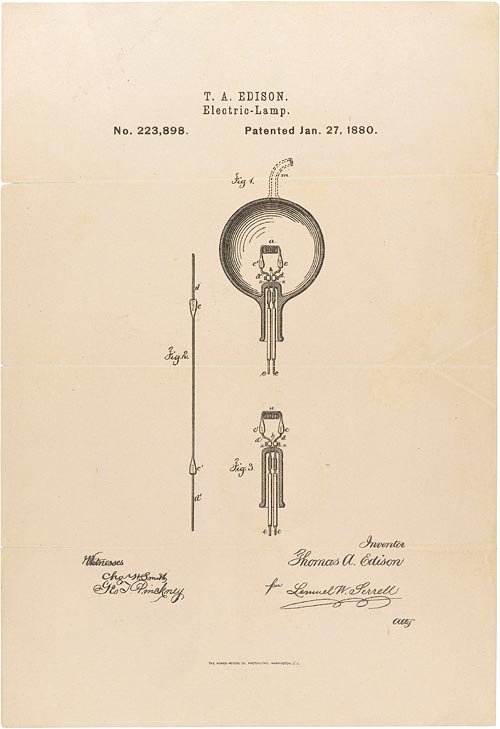
Image Credit: https://www.archives.gov/milestone-documents/
Early Power Generation
Edison’s Pearl Street Station was the nation’s first commercial power plant and by the end of 1882 was serving 82 customers and illuminating ~400 light bulbs. The coal-powered Pearl Street Station produced 600 KW of direct current (DC) electricity and its customer base quickly grew. By 1884 it was serving over 500 customers spread across the surrounding square mile.
While Edison and his team were working on direct current generators in the United States, alternating current was growing in popularity in Europe. Soon, Edison’s competitor George Westinghouse (along with Edison’s former employee Nikola Tesla) began championing AC power in the United States.
In 1895 Westinghouse’s Adams Hydroelectric Power Plant was built on the Niagara Falls, and soon was producing 37 megawatts of electricity and transmitting power up to 25 miles away to Buffalo, New York. This was not the first AC power plant in the US, but it was arguably the first that operated on a significant commercial scale and had long-distance transmission.
While Edison may have had a head start on Westinghouse, direct current had serious limitations in terms of how far its energy could travel. This meant that an electrical system running on DC would require many more generators than an AC system.
A whole mythology has sprung up about the “Battle of the Currents” where Edison’s “safe” DC was pitted against Westinghouse’s “dangerous” AC, but most of the stories are apocryphal and by the early 1890s it was clear that AC power had won.
Ease of long distance transmission meant that fewer plants were needed, and so inexpensive hydroelectric power could be used instead of coal-fired plants.

The American Power Boom
Some new technologies arrive slowly – with many people being reluctant to embrace change. Electricity did not face similar fears and its utility was immediately recognized.
Prior to electricity, homes were illuminated by candles and gas lights. Both of these presented major downsides such as fire risk, persistent soot deposits, and poor indoor air quality. Electric light bulbs were seen as an objective improvement and wealthy homeowners were eager to have their homes electrified.
In 1902, just 20 years after the first power plant came online, there were 2,250 power plants in the United States. By 1920 there were nearly 4,000 plants generating power and enabling millions of people to have access to electricity for the first time.
High Rises and Suburbs
Electrification didn’t just change how homes were illuminated, it changed how communities were constructed. Electric street cars enabled people to travel greater distances to reach their place of work. This meant that formerly compact towns could be spread out into the now-familiar suburban layout.
Additionally, electricity enabled the development of skyscrapers by introducing the electric elevator to the world. Previously, buildings rarely exceeded five stories – as the climb became increasingly tiresome. However, with elevators, higher floors actually became more valuable real estate because they offered unimpeded views without the drudgery of climbing stairs.
Electricity – Good For More than Just Light Bulbs!
Today lighting makes up a very small percentage of our overall home energy usage, but in the early 1900s it was where most of a home’s energy needs went. This meant that residential energy usage was highest during the night, and quite low during the day.
In the 1920s utility companies hired traveling salesmen to peddle electric goods like toasters, irons, hot plates, and hair dryers in an effort to boost day-time electrical demand. Their efforts were successful and these items quickly grew in popularity.
You can see the effects of electricity in fashion – with hair styles like the bob growing in popularity in the mid 1920s alongside the newfound availability of hair dryers.
Electricity Becomes Commonplace
While one of the major advantages of alternating current was its ability to travel great distances, during the 1920s most power was generated locally. This meant that cities and towns relied on a single (or perhaps a few) power generating stations and most rural communities were unpowered.
By 1932, only 10% of rural homes had electricity – and half those generated their own power with personal generators! This was a serious problem as it meant that rural communities were unable to take advantage of time and energy saving devices which their peers in cities had easy access to.

Image Credit:
Wikipedia
In 1932, Frank D. Roosevelt successfully won his presidential campaign partially on promises to bring power to rural communities. After he was elected he created the Rural Electrification Administration (REA) which paid out loans to local power cooperatives.
These efforts were bolstered when the US Federal Government formed the Tennessee Valley Authority in 1933 which helped bring power to rural towns and the Federal Power Act of 1935 which allowed the regulation of power transmission.
By the time that World War II came to an end in 1945, 90% of all households in America had electricity. A new era had truly begun for Americans, bringing with it refrigeration, air conditioning, radio, televisions, and eventually leading us into modernity.
In 1932, Frank D. Roosevelt successfully won his presidential campaign partially on promises to bring power to rural communities. After he was elected he created the Rural Electrification Administration (REA) which paid out loans to local power cooperatives.
These efforts were bolstered when the US Federal Government formed the Tennessee Valley Authority in 1933 which helped bring power to rural towns and the Federal Power Act of 1935 which allowed the regulation of power transmission.
By the time that World War II came to an end in 1945, 90% of all households in America had electricity. A new era had truly begun for Americans, bringing with it refrigeration, air conditioning, radio, televisions, and eventually leading us into modernity.
Image Credit:
Wikipedia
https://en.wikipedia.org/wiki/Rural_Electrification_Act
Birth of the Grid
Over time power generation grew to be increasingly interconnected, and today the United States is divided into three separate grids: Eastern, Western, and Texas.
For the average homeowner, the change to a grid-based electrical system was a net positive, as it added redundancy and helped to reduce blackouts. However, this benefit wasn’t universal – as demonstrated by the 13-hour long 1965 blackout which saw 30 million people plunged into darkness after a cascading failure swept the grid.
Learning About Safety the Hard Way
The dangers of electricity were known from the earliest days of power generation. Thomas Edison famously railed against the peril posed by alternating current (although the story of him electrocuting an elephant to prove this point is apocryphal), and above-ground power lines were a frequent hazard after storms.
Home electrical safety took time to come into its own – with grounded outlets, polarized outlet plugs, and GFCI protection taking decades to be developed and added to homes.
We’ve explored the history of home electrical safety in our last blog post – check it out here if you want to learn more about how electricity has been made safer than ever before.
The Future of Home Electrification is Being Written Today
Over the past century and a half, the world has been revolutionized by electricity. The earliest changes were dramatic and hard to miss – whether it was the invention of new technologies like light bulbs, or the breakneck speed at which electricity was introduced to new communities.
It can be easy to think that changes to home electrification are done – and we’ve hit a stable plateau, but that is simply incorrect. Whether it is the addition of solar panels to homes or the increasing percentage of electric cars which are charged at home, the way we use electricity continues to evolve day by day.
