Where Your Electricity Comes From: Understanding the Power Grid
Electricity permeates our lives in a way that is sometimes easy to take for granted. Every time we flip a switch, plug in a charger, or enjoy the cool breeze of our AC, electrons are flowing through your home’s wiring. However, outside of the very few of us who live ‘off the grid’, all of this electricity is produced far away and transmitted through an incredibly complex system to our homes.
Today, we’re going to get a better understanding of what the power grid is, its primary objectives, and what its future may hold. With this knowledge, you’ll leave with a better understanding of how this indispensable system works and why you may need to prepare for more blackouts in the future.

What is A Power Grid?
At its very simplest level, a power grid, known in the industry as a wide area interconnection or synchronous grid, is the system that distributes power from production facilities to homes and businesses.
In the United States there are three power grids, one for the eastern states, one for the western states, and one that serves most of the state of Texas.
Outside of a few very small connections – each of these grids is completely isolated from one another. That means power generated in Texas can’t be transmitted to Oklahoma and vice versa.
The Three Basic Components of the Grid
Each of the power grids in the United States are arguably some of the largest, most complex industrial systems ever built. But, despite the complexity all power grids consist of the same basic components: generators, transmission systems, and distribution systems.
Power Generation:
It all starts with power generation. This includes everything from coal powered plants to hydroelectric dams and wind farms.
Transmission Systems:
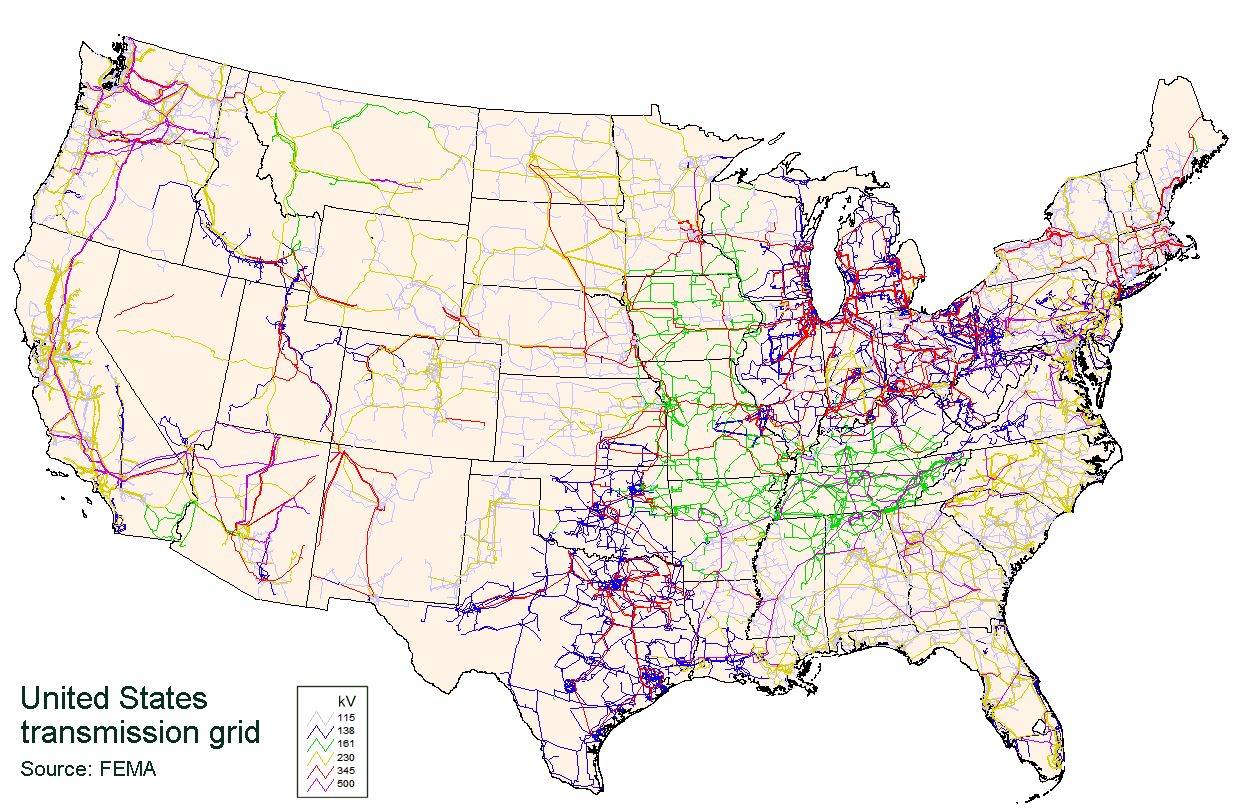
After power is produced at power plants it is transmitted via high voltage power lines. In the United States there are over 642,000 miles of these lines – moving power from where it is produced to distribution systems.
Transmission lines operate at extremely high voltages, up to 765 kV (765,000 volts), or more than 6,000 times the voltage of a typical household outlet.
Distribution Systems:
Once the electricity has been brought closer to where it will be used, the voltage is stepped down at using transformers at distribution substations. This lower voltage electricity then travels out on distribution lines to homes and businesses; there are over 6 million miles of distribution lines in the United States.
Distribution lines operate at lower voltages in relation to transmission lines, but are still considerably higher than household voltages. Typical distribution line voltages range between 2,300 volts and 39,000 volts. This is a big reason for why walking near downed power lines is never a good idea – even these ‘lower’ voltages are incredibly dangerous.
A final step-down transformer is necessary to turn these medium voltage transmissions into the low voltage that is safe to use in our homes. This last step is usually done quite close to where the power will be used.
The Three Goals of the Power Grid
The power grid serves three main goals to ensure that electricity is delivered safely and consistently to homes and businesses. Each goal is critical to keeping the lights on and the devices we rely on functioning properly.
Power Quality
One of the most important roles of the power grid is to deliver high quality power. What quality means in terms of electricity is having a consistent voltage level and a consistent frequency.
For our homes, the power usually comes in at 240 volts – although most of the wiring in our homes runs on only half of that and delivers 120 volts. Keeping voltage consistent is important as low voltage conditions result in brown-outs.
Frequency is the other component of power quality and refers to the rate at which the alternating current passes through zero volts each second. In the United States we operate on 60 Hertz systems, which means that this switch happens 60 times per seconds. Many devices rely on this rate of change to set internal clocks and may malfunction or even be damaged if the frequency varies too greatly.
Reliability
One of the most important benefits of a power grid is its increased reliability over direct power. In a non-grid based power system, you’d have a generator directly connected to your home. If this generator experiences a fault or needs to be taken offline for maintenance, then your home would lose power.
However, in a grid system a single point of failure won’t result in your home losing power. In fact, much of the complexity in our power grids comes from the added redundancy necessary to keep our lights on even in the face of problems.
This built-in complexity allows the grid to recover from problems quickly, minimizing outages and downtime. In practice, this means that even when there are storms or equipment failures, the power grid can typically reroute electricity and keep your lights on without you even noticing a problem.
Balancing Supply and Demand
Electricity is unique because it isn’t stored in large quantities like other forms of energy, such as gas or oil. Instead, it’s generated almost instantaneously to meet demand. When you flip a light switch, the electricity that powers the bulb was likely produced just a fraction of a second earlier. This requires constant balancing, known as “load following,” where the grid adjusts the amount of power generated to match demand.
Power operators use cheap power sources like solar or nuclear power to meet the ‘base demand’ and then turn on more expensive generators to meet variably higher levels of demand. Load balancing is one of the most complicated parts of a power grid as many types of power plants cannot simply be turned on and off and require lots of lead time to begin producing power.
Renewable energy presents unique challenges to load balancing as wind and solar energy are highly variable. A passing cloud or sudden storm can vastly raise or lower the power generation capacity of the renewable system, requiring compensation elsewhere in the grid.
Why the Grid Matters to Homeowners
The reason we all should know more about the grid is simple: it is too important to get wrong. However, the power grids have been chronically underfunded for decades while growing in size and complexity. This, in combination with more extreme weather events like heat waves, hurricanes, and winter storms, leads to a greater risk of power outages.
Ultimately, the issues plaguing the power grid are incredibly complex as there is no single governing body which controls it. Instead, it includes hundreds of companies and must comply with varying municipal, state, and federal regulatory bodies. While it is hard to say exactly what a path forward needs to look like, the first step is being able to recognize there is a problem which needs to be solved – particularly since the demands on the power grid will only continue to grow.
Preparing for the Future
The grid serves an essential role, keeping our homes and offices illuminated and ensuring that modern life can continue without interruption. However, improvements to the grid are slow in coming and are made more complicated by its distributed nature and the numerous entities responsible for its upkeep and development.
As a homeowner, it’s essential to be aware of these potential problems so you can make informed decisions about everything from who you choose for municipal elected positions to whether or not a whole-home backup generator is right for you.
